
Camiel Jansen speech ‘The State of Dutch New Music’ 2026
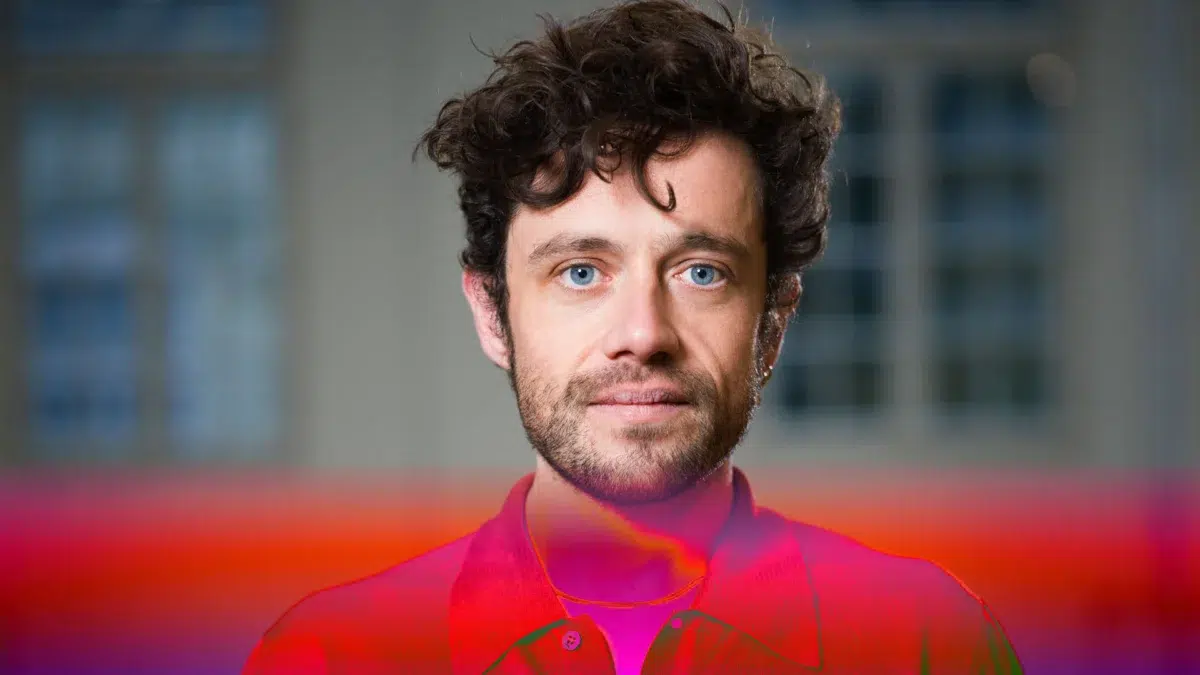
This article was first published on Gaudeamus.nl.
A door in an infinitely long, white room, without windows and without a ceiling, opens slowly, and a young composer steps inside. In the sterile space stands a piano alongside numerous other small instruments. The young composer looks around somewhat desperately and hesitates, but eventually sits down at the piano and begins tinkering. He is searching for a specific sound, but he does not know exactly what.
After endless hours, a wise figure appears behind him. Thin face, long robe, grey hair in a braided ponytail.
‘It will never work this way,’ she says in a booming voice.
For the recipe for music, oh young composer, consists of two ingredients, and you are currently cooking with only one. Music is a combination of sound and attention. The attention of the creator, of course, but also the attention of the listener. Only with these two ingredients, in a proportion determined by you, does music emerge.
She continues: ‘John Cage already proved in 1952 with his 4’33” that the more attention the music receives, the less sound is needed. Later, he proved the opposite of that premise, not by opening the piano lid, but by throwing open the windows of his living room during a concert in his apartment on a busy street in New York, thereby turning the cacophony of dreadful noise into music.’
The young composer weighs his words and answers after a while: ‘Then perhaps I should not be looking for the perfect sound, but for the perfect attention. Will you be my attentive audience?’
The wise old woman mumbles: ‘Yes, sure, but maybe later; I am busy right now,’ and she picks up her phone.
Composer of the Netherlands
It is April this year, I have been working as Composer of the Netherlands for four months and I have been asked to write a piece for the Day of the Composer. The Day of the Composer is a celebration of contemporary Dutch music, with hundreds of pop-up concerts throughout the country, string quartets, amateur choirs, professional choirs, the list seems endless. On June 20, I am told, the idea is that all these ensembles will play and sing a piece of mine. The piece should last no more than a minute and a half, should be very simple and therefore can be performed both instrumentally and a cappella. I worry about all these moving parts.
During the writing process I find it difficult to concentrate, and after a few weeks I hand in a piece that I think will work, but which I mainly wrote as a kind of creative exercise. Very little new music comes to me during this period, either as a maker or as a listener. More and more often I listen briefly while I’m doing something else; there’s not really much depth to that.
And that raises a question that I would like to ask today: what happens to contemporary classical music when the deep attention needed to experience this music is less and less available?
More and more often I, and many others, let my streaming platform choose for me what should be played, with an automatically generated playlist, which often aims to create an atmosphere in a space. For a while I tried to use my old iPod again, but that turned out to be a big step back from the comfort of an algorithmically determined, infinitely large and always accessible music library, hidden behind a green icon on a device that, in addition to that library, also demands attention for cat videos, updates from friends, banking, AI chatbots, podcasts about politics and polyamory, and an advertisement for an air fryer.
Perhaps you have heard this lament mainly from other people, or perhaps this gives you the impression that this is something that I, in particular, am struggling with. It would not be unreasonable to think this.
So: have people actually become so much less good at paying attention?
A few statistics:
Spotify’s internal research into users’ skipping behaviour concludes that a quarter of all streamed songs are cut off within the first five seconds, and only about half of the songs are listened to in full. This persistent listening behaviour has been given its own term in the music industry: “lean-in” listening, with attention, versus “lean-back” listening, in the background.
Another analysis of Spotify streams by marketing agency Y2M shows a similar picture: more than 21% of the streams in an average listening session are now determined not by the user, but by the algorithm.
Music has also changed in terms of content. A recent estimate by the Washington Post shows that the average song length is dropping by 2.5 seconds per year. Music is therefore not only listened to differently, but also written differently.
You might be thinking to yourself: but Camiel, this is mainly about pop music. We make modern classical music. Different rules apply to us. We don’t do refrains and hooks, nor do we earn our money from royalties. We are a niche and will always remain so. Yet, even among us, in classical music, a subgenre has emerged that perfectly reflects the logic of the market and fleeting attention: neoclassical. Neoclassical is a genre that is ideally suited for a lean-back listening experience. The popularity of this genre is growing; the Einaudis of the world are filling stadiums.
And there is another development within music that is driving lean-back listening behaviour. Artificial intelligence can now generate an infinite amount of music on demand, within a few seconds. On streaming service Deezer, one of the few platforms that shares figures on this, more than half of the released music is now entirely generated by AI.
That sounds scary, but: research shows that only 1% of actual listening time is devoted to AI music. In other words: high volume, hardly any attention.
And yet, fair is fair, when the court in Munich ruled a few weeks ago that AI model Suno had violated copyright and had to pay damages to the German copyright organization Gema, I was cheering in my living room.
But Camiel: technology does what it always does anyway: drastically change the world. What does it matter that this deep attention is disappearing? Don’t you also have a responsibility as a creator to go along with this change?
Actually, that question isn’t quite right. There may not be less total attention, but there is less dedicated attention. In the past, we were bored and there was little to do, so we looked for something ourselves to devote our full attention to. Now it is the other way around. Everything demands a piece of us throughout the day, and full focus is no longer the standard way of working; it is something we must actively seek out and defend.
We can still do it, by the way. The fact that people still sit through three-hour films doesn’t prove that nothing is wrong, but rather that we now need to reserve that attention much more consciously. And that consciousness—that is where, in my opinion, the responsibility lies for us as creators. Making music in 2026 is no longer just about bringing sound together; it is also about asking for something. I compose, so I am now asking for a piece of your increasingly scarce attention. As a composer, I cannot take that request for granted, and that, I believe, is how modern classical music must relate to the present. Starting with the awareness that attention must be asked for, perhaps even earned.
Composer’s Day
Back to Composer’s Day. It is June 20th, and concerts are being organised at all kinds of locations throughout the Netherlands. I get to travel along on a musical train journey from Arnhem to Groningen, where concerts are held at the stations, both in the hall and on the train. Musicians play works by Dutch composers: saxophone quartets, violin duos, and so on.
It is a wonderful concept. Instead of bringing the audience to the concert hall, we bring the concert hall to the audience. On the train, top musicians play beautiful Dutch works that hold up remarkably well outside a stage. Yet, it is a peculiar scene: travellers who had actually expected to sit quietly on a train are now surprised by live music. After a few initial minutes of excitement, you notice that many travellers lose their focus a bit, sink into their phones, and that the musicians are playing mostly for themselves (with the exception of a few engaged listeners). That is not a problem; we organise such a day primarily to make people reflect on the power of live music, and of course, we do it for that handful of listeners we do manage to move—and that actually works surprisingly well in station halls. But it does make me think: this kind of intricate music cannot really exist without genuine attention.
The day after the train journey, a closing concert takes place at TivoliVredenburg, and I get to host the event. A number of beautiful compositions by composers living in the Netherlands are performed, accompanied by the Radio Philharmonic Orchestra, and prizes are presented. Joey Roukens wins the Buma Classical Award, and Huba de Graaff receives the Buma Classical Lifetime Achievement Award. During her speech, she says something that perfectly puts into words cursory thoughts that had occurred to me the day before on the train. She recommends a renaming of the term Classical Music.
She argues that ‘classical music’ not only sounds dusty, and evokes associations with men wearing wigs, that deter the uninitiated, but also that the term has been hijacked more than once by far-right political cliques.
No, she says, there is actually no such thing as Classical Music anymore. We should actually be talking about Music with Classical Attention. Music that you take in with full surrender. That you experience while doing only one thing at a time. And that is a commodity that is becoming scarcer, but not everywhere.
I want to take Huba’s clever proposal to call classical music ‘music with classical attention’ from now on a step further. I believe that in this era of shifting attention, a new persuasive power is emerging within Dutch concert halls. A unique selling point, to put it in business terms, that we can employ more.
Concert venues are one of the last places where you still do something with full attention. Concert halls in the Netherlands have another function besides being a stage for culture: acting as a funnel for the visitor’s attention. A kind of sanctuary. And people like that. It is nice when something or someone demands your full concentration. I think venues and festivals in the Netherlands could focus more on this. Perhaps phone lockers before a concert would be nice additions to this, or drinks afterwards to chat, or a few minutes of silence before a concert begins. I believe that here, in our small country, in which venues for new music are vulnerable, lies a new value for our audiences.
After Huba’s beautiful words, Joey Roukens’ new violin concerto, Out of the Deep, sounds as the closing piece of the evening, with Simone Lamsma as soloist. I take a seat in the hall and hear how Roukens has composed a piece that gasps for breath, that feels like a great journey to the surface of the water. The orchestra coils around Lamsma like a water snake, and her notes are full of power and depth and love and virtuosity, and I have goosebumps from beginning to end. At the final note, I have tears in my eyes. I have that only because this music was experienced by an audience member who listened with the same attention with which it was composed, and that attention—that is what a concert hall commands, that is our great strength, and that must be our answer today.
Camiel Jansen, 2026
Read the other ‘The State of Dutch New Music’ speeches
2025: Bart de Vrees

2024: Calliope Tsoupaki

2023: Aart Strootman
